Why 2026 must be the year of citizen participation
For many citizens, participation begins and ends with voting
As India enters 2026, the country stands at a critical inflection point. Urbanisation is accelerating, aspirations are rising, and governments at all levels are under pressure to deliver faster, better, and more inclusive outcomes. Yet one challenge cuts across geography, income, and politics: the growing distance between citizens and the institutions that govern them.
Across India’s cities and towns, civic engagement remains shallow. For many citizens, participation begins and ends with voting. Governments, too, often treat elections as the sole indicator of democratic health. But democracy is not a periodic event – it is a continuous relationship. If India is to build resilient, responsive, and trusted governance systems, 2026 must become the year of citizen participation.
Recent surveys from multiple cities point to a common pattern: low awareness of local civic institutions, limited understanding of budgets and decision-making processes, and weak access to participation platforms. At the same time, a strong majority of citizens express a desire to be more involved in shaping their neighbourhoods and cities. The problem, clearly, is not apathy – it is disconnection by design.
Citizen participation must therefore be actively built into governance. Here are ten nationally relevant ways India can make 2026 a turning point.
Redefine citizenship beyond voting
Voting is foundational, but it is not sufficient. A mature democracy requires continuous engagement – questioning policies, tracking outcomes, and contributing to solutions. Citizenship must be understood as an ongoing responsibility, not a once-in-five-years act.
Make local forums the backbone of democracy
Ward sabhas, gram sabhas, town halls, and neighbourhood meetings must become predictable and outcome-driven. Regular, accessible forums – held in local languages and at convenient times – should allow citizens to raise concerns and review progress. Crucially, governments must close the feedback loop by reporting what action was taken.
Create integrated civic response systems
Fragmented governance discourages participation. Citizens often do not know whom to approach or where responsibility lies. Integrated civic control rooms – bringing together municipal services, utilities, health, transport, and grievance redressal – can simplify engagement and make accountability visible.
Use technology to inform and listen
Digital governance must move beyond portals and apps that only collect complaints. Technology should explain budgets in simple terms, show project timelines, invite citizen ideas, and enable participatory budgeting. Digital tools must always be complemented by offline access to avoid exclusion.
Shift from consultation to co-creation
Public consultation alone is no longer enough. Governments should actively involve citizens, students, professionals, and civil society in designing solutions through planning workshops, innovation labs, and open data initiatives. Governance improves when citizens become collaborators, not spectators.
Balance citizen rights with citizen responsibility
Participation cannot be reduced to demands alone. Citizens must also embrace responsibility – by engaging constructively, respecting public assets, and contributing time and effort to local problem-solving. Democracy weakens when accountability is fully outsourced to the state.
Institutionalise citizen audits and dialogue
AGM-style dialogues between citizens and civic bodies can transform transparency. Citizen audits of local works, service delivery, and budgets should become routine. Regular scrutiny builds trust and improves performance.
Measure participation, not just deliverys more
Governments rigorously track infrastructure and service metrics but rarely measure civic awareness, trust, or engagement. This is a blind spot. Every city and district should conduct standardised civic participation surveys at least twice a year to assess awareness, access, and confidence in governance – and publish the results.
Align political intent with systems
Leadership matters, but intent alone is insufficient. Citizen participation cannot depend on individual officers or political will alone. It must be embedded into rules, timelines, performance metrics, and budgets – so it survives electoral cycles and administrative transfers.
Treat participation as a governance outcome
Finally, citizen participation must be recognised as a core outcome of governance – not a disruption. Engaged citizens make policies smarter, implementation smoother, and institutions more credible. Participation is not a cost; it is an investment.
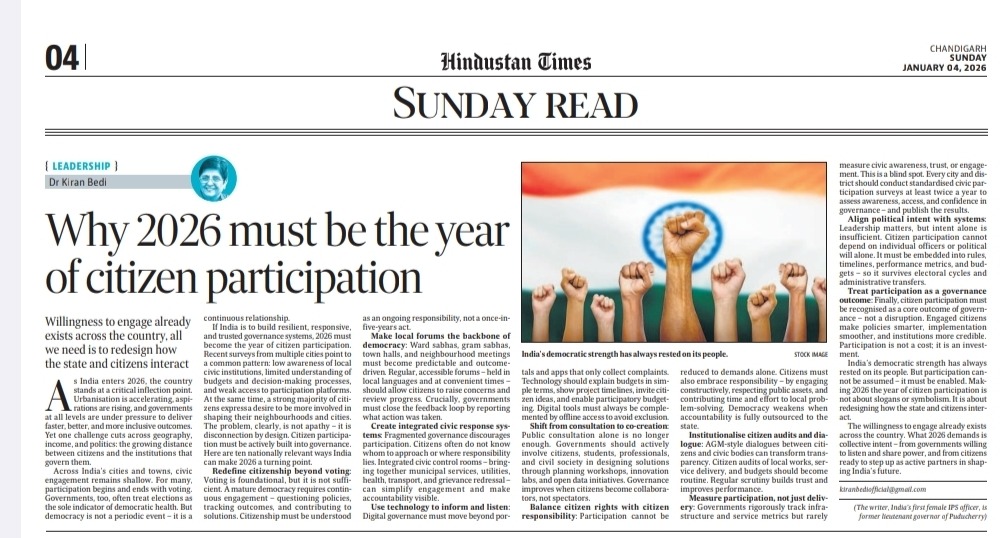
India’s democratic strength has always rested on its people. But participation cannot be assumed – it must be enabled. Making 2026 the year of citizen participation is not about slogans or symbolism. It is about redesigning how the state and citizens interact. The willingness to engage already exists across the country. What 2026 demands is collective intent – from governments willing to listen and share power, and from citizens ready to step up as active partners in shaping India’s future.
kiranbediofficial@gmail.com
(The writer, India’s first female IPS officer, is former lieutenant governor of Puducherry)