Securing the seas: UN mandate for maritime peace

Including both western and Global South navies would enhance legitimacy and maintain strategic balance. It reinforces a fundamental principle: The seas are a global commons, and their security must be collectively ensured.

The emerging frontier of conflict is no longer land alone — it is the sea. From the Strait of Hormuz to the South China Sea, maritime spaces are rapidly becoming arenas of strategic contestation. These waters carry the lifeblood of the global economy—energy flows, trade routes, and supply chains. Any disruption here is not regional; it is systemic, with immediate global consequences. Nearly one-fifth of global oil consumption transits through the Strait of Hormuz, underlining its strategic fragility.

Unilateral military responses are increasingly insufficient to secure critical chokepoints such as Hormuz. Evolving deterrence dynamics in the region have altered the strategic balance.

Decades of reliance on unilateral actions and bilateral escort arrangements appear to be reaching their limits. Even recent multilateral efforts, including the April 2026 London Summit, where 40 nations aligned to address the situation, did not yield a durable consensus. This reflects a broader gap in institutionalised approaches to maritime security.

Recent high-level political engagements leading to a temporary easing of tensions linked to the Strait of Hormuz underscore the ad hoc and fragile nature of current crisis management mechanisms. Such developments highlight how critical global chokepoints continue to be managed through reactive and transactional arrangements rather than stable institutional frameworks.

French President Emmanuel Macron has cautioned that weakening adherence to the United Nations Charter risks eroding the credibility required to prevent conflict. A UN-led approach can reduce perceptions of bloc politics and power projection, thereby lowering escalation risks. Any sustainable solution must therefore be anchored within a UN framework, the only platform with universal legitimacy.

Maritime peacemaking

The United Nations’ peacekeeping architecture remains largely designed for land-based conflicts. This structural mismatch is increasingly evident in the current maritime environment.

Traditional peacekeeping evolved in an era of clearly defined wars and ceasefires. Today’s maritime tensions are fluid—shaped by grey-zone tactics, calibrated brinkmanship, and the persistent risk of escalation without formal war.

The absence of neutral, UN-backed maritime rules of engagement increases the risk of miscalculation. In such an environment, deterrence without institutional structure becomes inherently unstable.

A strategic shift is required from passive observation to active maritime peacemaking and peacebuilding. The UN is uniquely positioned to anchor such an effort.

There is precedent. The UNIFIL Maritime Task Force, operational since 2006, has demonstrated the feasibility of UN-led maritime security operations in supporting Lebanon’s sovereignty and monitoring its waters. This experience offers a foundation for expanding UN engagement into broader maritime domain operations.

Building on this, the UN can extend its mandate to help secure critical global sea lanes.

Pathway for action


The way forward is both practical and grounded in established UN processes.

It may begin with an emergency special session of the UN General Assembly—challenging, but feasible—to elevate maritime security as a global priority and frame secure sea lanes as a shared international responsibility.

This can be followed by a UN Security Council resolution providing the necessary legal mandate. The council has authorised complex land-based missions; extending this framework to maritime domains is both logical and timely.

Once authorised, the UN can activate its institutional mechanisms—force generation, command structures, and operational guidelines—drawing on decades of peacekeeping experience. A clearly time-bound mandate, supported by periodic review mechanisms, can address concerns over mission creep.

Coalition of willing

The operational core can rest on a coalition of the willing. Capable naval powers and maritime nations can contribute assets, such as ships, surveillance systems, and expertise, operating under UN authorisation.

This hybrid model combines legitimacy with capability, ensuring both accountability and effectiveness. It distributes responsibility, enables coordinated deployment, and sustains presence in sensitive regions.

Inclusion of both western and Global South navies would enhance legitimacy and maintain strategic balance. Above all, it reinforces a fundamental principle: The seas are a global commons, and their security must be collectively ensured.

Maritime stability cannot be sustained by naval presence alone. A parallel emphasis on peacebuilding is essential—strengthening regional maritime cooperation, enhancing coastal security capacities, and supporting dispute resolution mechanisms.

Targeted capacity-building for littoral states can promote long-term sustainability and reduce dependency. Stability at sea remains closely linked to governance on land.

A global necessity

Scepticism around expanding UN mandates is understandable. Yet the greater risk lies in inaction.

Unregulated competition in maritime spaces could disrupt global trade, heighten tensions, and undermine international stability. The consequences are already visible.

Delayed multilateral responses have historically resulted in significantly higher economic and strategic costs. The UN does not lack the tools, it possesses institutional experience, established frameworks, and global credibility. What is required is the political will to adapt these instruments to evolving realities.

A UN-led maritime peacekeeping and peacebuilding framework can be both practical and effective. However, its success will ultimately depend on alignment with the political interests of the five permanent members of the UN Security Council: The United States, Russia, China, France, and the United Kingdom.

Enduring maritime stability lies at the intersection of global necessity and great power consensus.

The seas have always connected the world. Today, they also expose its vulnerabilities. Securing them cannot be left to fragmented efforts. It requires a coordinated, legitimate, and forward-looking response.

A UN-mandated maritime peace mission, anchored in a coalition of the willing, is no longer merely a strategic option. It is a global necessity. This is a cause that calls for wider global awareness and engagement

kiranbediofficial@gmail.com

Kiran Bedi is a former police adviser to the UN Secretary-General (peacekeeping operations under Kofi Annan). Singh is a Chhattisgarh-cadre IPS officer and author of a book on the United Nations Peacebuilding Commission. Views expressed are personal.


Scroll to Top
Please enable JavaScript in your browser to complete this form.

Empowering Lives

DOWNLOAD BOOK

Send download link to:

ACP New Delhi and Gallantry award

When Kiran Bedi was ACP Delhi, the Akalis and Nirankaris were fighting against each other and the Nirankari’s were leading an agitation towards the India Gate and Vijay Chowk. She went along with her DCP Platoon to stop the mobs from reaching Rashtrapati Bhavan and the parliament house. But they tried to enter all the roads which led to these buildings. Kiran Bedi kept running from one road to another controlling these mobs. Soon she found herself all alone, fighting against these mobs and all she had in her hand was a wooden baton. She went ahead with the sheer sense of duty and fought against them and controlled the mob single-handedly. She was injured during this operation but didn’t let the pain stop her from doing her duty. For this courageous act, she was awarded the President Gallantry Medal in 1979.

DGP BPRD

When Dr. Kiran Bedi took over as DGP, BPRD, she realized that despite BPRD being the only central agency of the Government of India to critically look at police research it did not have proper systems in place.

The bureau did not have enough funds, hardly any research was being done and the name BPRD itself was a misnomer.

She soon began sending one-page monthly reports to the Union Home Minister and the Home Secretary listing work done by the BPRD and reminding them about pending issues.

She remained persistent with her work on sending these reports although not even one of these reports was acknowledged. She also worked on modernizing the bureau by setting up its website with the help of NIC. She also held regular meetings with registrars of various Universities encouraging research on policing.

BPRD soon began receiving funds and for the first time, they received funds from the  Planning commission of India.

Dr Bedi always believed in giving her best to every assignment and posting that was given to her and in this posting as DGP, BPRD also she gave her best the result of which is seen in the functioning of BPRD even today.

Police Advisor UN

During her posting at the United Nations, Kiran Bedi put in place very intensively considered operating procedures guidance, documents and policies for peace keeping operations. In an interview she once said, “ When Indian police officers wok for international peace and security they act as India’s ambassadors of peace and come back with a larger vision of policing though global experience. They are able to experience internationally respected practices and evaluate what is relevant for their work back home. In some cases, it may make them more confident of their comparative strengths and professional calibre.”

In the year 2004 she engaged in a lot of peace keeping operations and the team was known as , “ blue. Helmets”.  Some of the countries where the team worked include  places in Africa and the Caribbean like Cote D Ivoire, Haiti, Burundi and Sudan.

Another significant contribution of Kiran Bedi to these peace keeping operations was involving women police officers. For example in Timor Leste more than 25% of the peace keeping force created were women. These operations directly benefit women as they themselves are victims of internal civil wars and they become inspiring role models for nation building.

Joint Commissioner PTC

As she took office, she realized that the College lacked facilities and the cadets were ill-trained. As she was informed of the induction of 1700 new cadets for training while the college had no facility to teach or accommodate them. A teacher at heart she was looking forward to sharing her knowledge with the cadets but found that the College lacked facilities like a proper IT training center.

Going by her earlier practice of having a petition box, she started the system of a feedback box at PTC. Students could write in with their concerns and this kept the teachers also on their toes and none could get away with not teaching properly. The key to the box remained with her and she made it a practice to have lunch with the senior officers of PTC.  During the lunch hour, the box would be opened and they would look at all concerns together.

For the first time, Vipassana meditation was introduced in police training college. Kiran Bedi also did the course with all the cadets and it was a historic moment to see the entire training college do meditation together.

Through her work, in four years a dilapidated institution was reformed into an elite one.

L G House

In this posting, she was to assist the Lieutenant Governor, Delhi in city management. One of the tasks given to her was to facilitate grievance redressal and ensure that all agencies of the Delhi government delivered. Since this was not a serious concern earlier, there existed no infrastructure to respond in the manner Mr. Tejendra Khanna, the new Lieutenant Governor wanted. Kiran Bedi in the shortest possible time went about to set up a whole new system of grievance redressal which perhaps is the most comprehensive system devised by any governor’s office in India

Without an existing law on the Right to Information, the new system empowered the citizens to get their problems addressed. A comprehensive interactive system was set up called the Public Redressal Unit. It enabled anyone to reach the LG office through phone, mail, fax, and even personally. Each matter was computerized, acknowledge, responded to, referred, followed up, reviewed, test checked in selective cases, and the complainant was informed of the outcome before the matter was closed. Thereafter each unit’s performance was assessed and circulated. The redressal unit co-opted Citizen Warden appointed by the Lieutenant Governor’s office. They were eminent and concerned citizens who volunteered their time. During her tenure, 64,403 matters were addressed to 71% satisfaction. People of the city remember this system. It was a road map to good governance.

IG Prisons Tihar

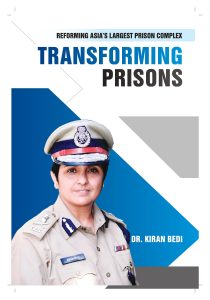
In 1993 Kiran Bedi was posted as DIG prisons in Tihar jail. She made history by completing reforming the prison making it into Tihar Ashram. Before she entered Tihar, the prisoners lacked most basic facilities ranging from lack of access to food to lacking sanitary conditions. While at Tihar, Kiran Bedi was dedicated to turn the Prison into a reformative ashram. She immediately ordered for better sanitary and health facilities in the Prison and took to frequent rounds for inspection of these facilities. She was of the firm opinion that her role was not to be judgmental about the crimes of even hardened criminals but to provide them opportunities where they can live a safe, secure, healthy and comfortable life. In the brief regime of Dr. Bedi, rigid and distant hierarchies were broken down. The prisoners were protected and stood enveloped from all sides- officers, staff and the useful members of the community. She also introduced the system of mobile petition box. It was introduced to counter gossip network which was marked predominantly by secrecy, callousness and indifference, to counter which locked box was circulated among the prisoners. They wrote about their problems like water scarcity, unsatisfactory cleanliness, ineffective supervision, absence of doctors and non-availability of medicines. Through these mobile petition boxes, suggestions were given for improvement, valuable information provided, creativity encouraged by sharing, feeling of gratefulness expressed, also grievances against police, court and lawyers expressed. To empower women’s conditions in the prison, they were firmly made literate by inmates as well as outside teachers. :A great tragedy with these women was that their children born in their prison time were had to also remain in prison amid all those dire circumstances. Confined in the four walls of the magnanimous Tihar jail, they were deprived of their childhood. To improve their conditions, Mahila Pratiraksha Mandal was established. Nursery school was established to teach 60 children who were deprived of their basic human right without any fault of their own. To keep the prisoners busy as well as equip them with necessary skills to earn livelihood in future Kiran Bedi also introduced opportunities for vocational training. From introducing education to bringing in vocational training and meditation programs like Vipassana in prison, her reformative work in Tihar won her international acclaim. She was awarded the Ramon Magsaysay Award in August 1994 wor her work in prison reform. With the prize money she started the India Vision foundation for prison reforms. The foundation has completed 27 years of working in this field.

Mizoram- DIG Range

Mizoram was a whole new terrain for Kiran Bedi to handle. The place, the culture of the people, the challenges were all completely new for her. But soon she began to mingle with the people, understand their needs and their culture, and started to find solutions to their problems accordingly. Mizos as a tribe involve themselves in a lot of music and singing. So to curb the problem of drug abuse, she encouraged them to practice a lot more music, to divert their mind and rehabilitate them.

Kiran Bedi, during this time also managed to do a good amount of work for her Ph.D. thesis on drug abuse and domestic violence which she was pursuing from IIT Delhi.

Where_Kindness_Spoke

DOWNLOAD BOOK

Send download link to:

DCP North

She also set up a detox center in one of the police stations and this eventually led to her setting up the NGO Navjyoti Delhi Police Foundation for correction de-addiction and rehabilitation, which even today works to educate the poorest of poor as the Navjyoti India Foundation.

The foundation initially functioned out of police stations and gradually got a set-up of its own. The foundation worked extensively with the slums of the Yamuna Pushta area, setting up gali Schools for them. This whole slum shifted to Bavana and Navjyoti Foundation continues to work with the community in Bavana.

She was also made the deputy director Narcotics Control bureau in 1988 when she led an operation to destroy opium being grown in Chakrata district near Dehradun.

This was also the time when she faced the lawyers’ agitation for having arrested a gentleman for some incidents which happened in a women’s college. This gentleman turned out to be a lawyer practicing at the Tiz Hazari complex and there were mass protests against this arrest. The Bar association wanted Kiran Bedi to be suspended but she was transferred out and the then Police Commissioner Ved Marwah supported her.

Deputy Director at Directorate General of Industrial Contingency, Department of Industrial Development

Kiran Bedi’s role as the Deputy Director at the DGIC was a decisive one. For her, it was a refreshingly different experience to work at a non-police department. Primarily the department dealt with monitoring of industrial relations and sending out intelligence and analysis reports. Within the first three weeks of working in the new office, she sent a detailed report of her observations on the shortcomings and measures for effective functioning of the department. As in most of her other postings, Kiran Bedi once again set off to check realities on ground going beyond office walls and based on her observations, she drafted some trend setting reports for circulation. Some of the most important directives and recommendation in her report included industries to adopt practices such as a five minute warm-up exercise before the start of work, having same meals in common canteens for workers, wearing of a uniform to induct a sense of cohesiveness and unity among workers, better leave facilities with incentives, etc. Due to her vigilant work, suggestions and reports, the DGIC gradually made its presence felt and its report were being sent to the decision makers for coordination. This of her posting gave Dr. Bedi a chance to gain practical experience in management. When workers at a cement plant in Bokajan, Assam held a strike, she was called upon by her Director General to resolve the strike. She gladly agreed for the task and within twenty four hours of her arrival at the unit, Dr. Bedi with the help of the District Deputy Commissioner was able to sign an agreement ensuring that the workers’ demands were satisfactorily met and they returned to work. Her extensive work at the DGIC really transformed the working of the department.

Special Traffic Police, Goa

One of the first few steps that she took as the DCP Traffic of Goa was to rejuvenate the officials by inspiring them, following which the traffic force became efficient and for the first time in years, Goans witnessed traffic police involved in resolving traffic snarls. Like all her previous postings, this one too had Kiran Bedi in a conflict with the VIPs and ‘babus’ who took rules for granted. On several occasion she faced drifts with VIPs who took traffic rules for granted, the drift went to an extent where for the cause of upholding the law, refused the Chief Minister when he asked her to withdraw police action from the VIP Cars illegally parked.

While she was in Goa, a bridge was built over the Zuari River but was not brought to use just because there wasn’t a VIP inauguration for it and was rendered inaccessible for the public. While on patrol one day, Kiran Bedi found a huge snarl-up at the ferry point and decided to immediately order the removal of blockades from the bridge and diverted the traffic towards it, thereby ‘inaugurating’ the bridge in the most down to earth manner.

The same year Goa hosted the Commonwealth Heads of Government Meeting(CHOGM) which involved a visit from heads of state of governments from around the world. Kiran Bedi once again found herself in charge of managing the traffic arrangement of a prestigious international event. But this time it was all the more challenging for her since it was impossible to manage traffic on a 40km route during a high-level visit with a force of mere twenty-five officials. But with her wits, she saw that the people of Goa were enthusiastic about the event and decided to involve the NCC Cadets in traffic management after training them on Sundays. Another grand success came Kiran’s way as she ensured smooth management of the traffic during the CHOGM.

DCP Traffic

During her tenure as DCP Traffic, Kiran Bedi introduced numerous reforms for reformation of the broken system and effective traffic management in Delhi. Among these, two of her reforms were most notable. Upon noticing how the rich and privileged class evaded the ‘challans’ issued to them, she insisted that the ‘challan’ system be replaced by an on-spot fine. While the privileged evaded ‘challans’ and adopted a do-what-you-want attitude towards the authorities, the spot fine introduced a whole new system where no amount of influence or highly placed friends could come to the help of those who evaded the traffic rules. The reform enhanced the quality of traffic management and also helped in bringing individuals to book.

Another challenge Kiran Bedi realized was the traffic snarls caused due to broken down vehicles parked on either side of the roads as well as vehicles wrongly parked. She began deploying cranes to remove any such vehicles wrongly parked or stacked due to being broken down. In one such incident, Sub-inspector Nirmal Singh with her permission towed away the car of the PMO wrongly parked in Connaught place. This won her the moniker ‘Crane Bedi’.

She successfully managed the traffic during the Asian Games and was even offered the Asian Jyoti award, which she declined saying it did not belong to an individual but to the entire Delhi police force.

DCP West

AS DCP West, Kiran Bedi introduced the system of beatboxes which was a simple concept of neighborhood policing. In less than a month she set up more than 100 blue and white beatboxes in the area and what was interesting was that these were mostly funded by the donations coming in from the area itself.

As the DCP West, Kiran Bedi had assured the people that not a single case of arbitrary arrest would take place in her area. When a person who earned his living by selling vegetables and was a reformed and rehabilitated erstwhile criminal was arrested arbitrarily because of a dacoity committed in South District, his family approached Kiran Bedi in the hope of help and claiming a breach of trust. She found herself in a situation where the case was not under her jurisdiction. Despite that, she approached the Commissioner of Police who ticked her off, conveying that she needn’t be involved in the case. As a dedicated public servant, Kiran Bedi conducted her investigations and concluded that the accused was not at fault. Her investigations were, however, rejected by the South District which had already solved the case within 24 hours. It is with many difficulties and after the press coverage of the investigation undertaken by her that the accused was finally released and she was able to expose the spites of South District Police

ASP Chanakyapuri

Kiran Bedi was the senior-most probationer and should have been the chosen one to lead the republic day parade. But she heard that an officer junior to her had been chosen to lead the parade and she had been overlooked just because she is a woman. She met her senior officer Mr. P R Rajagopal and asked him why she was not allowed to lead the parade. He in turn asked her, ” Kiran you mean you can lead the parade?” to which she replied, ” Why not sir, I have trained equally with the boys and I can easily lead the parade.” He immediately shook hands with her and told her she would lead the parade. In the harsh winters of Delhi, she would practice marching with a sword in her hand 14 kms every day. She did lead the parade and became the first woman to lead an all-male contingent in the Republic Day Parade. Seeing a woman lead the parade, the then Prime Minister Smt Indira Gandhi cheered for her and invited her for breakfast the very next day.

IVF_Transforming_Prison

DOWNLOAD BOOK

Send download link to:

Training at National Police Academy Mt Abu

The then-home secretary K C Pant tried to dissuade her from joining the police service as there were no women in it before her. But Kiran Bedi was determined to join the police service and the sports and NCC background she had gave her the confidence to step into this male-dominated field. Even at the academy, she was asked if she would like a different uniform, or would like different training from the boys. But she chose to wear the same uniform and take the same training as the boys. She would beat the boys in marathons, tennis matches, and other training games. All the boys in her batch looked up to her and knew they had tough competition ahead of them.

TENNIS

She grew up playing tennis and believing that in this world there is no time for losers. To be a winner one just needed the right attitude and right strategies. Her father used to tell her, “ life is on an incline you either go up or you come down,” and she knew she had to always work her way up the ladder.

She won the National Junior championship in 1966 and the senior National title in 1974. She also became the Asian tennis champion in 1972. She played competitive tennis from the age of 13 to the age of 30 even after joining the IPS. She travelled the length and breadth of the country playing matches and tournaments, travelled with the boys and beat them in many matches too. She was one of the few girls of her times playing tennis that too from a tier two city like Amritsar.

Kiran Bedi, always believes that if not for tennis, she wouldn’t have been able to make it to the police service. Tennis gave her the stamina and also  her attitude for life and strategies she uses, were also learnt by her through tennis. She learnt the value of hard work and persistence through tennis.

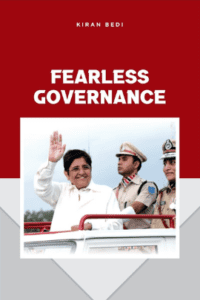
fearless-governance

DOWNLOAD BOOK

Send download link to:

Its always possible

DOWNLOAD BOOK

Send download link to:

as i see

DOWNLOAD BOOK

Send download link to:

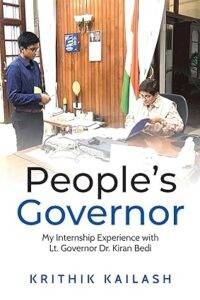
pepoles governace

DOWNLOAD BOOK

Send download link to:

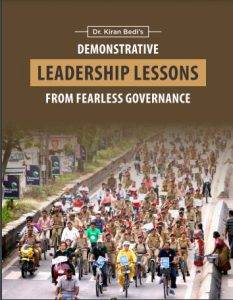
Leadership Lessons

DOWNLOAD BOOK

Send download link to:

I_Dare_Complete_book.

DOWNLOAD BOOK

Send download link to:

# Morningnutrition1

DOWNLOAD BOOK

Send download link to:

# Morningnutrition1

DOWNLOAD BOOK

Send download link to:

Fearless Punjabi

DOWNLOAD BOOK

Send download link to:

Ye Sambhav Hai

DOWNLOAD BOOK

Send download link to:

BRS 5 YEARS

DOWNLOAD BOOK

Send download link to:

The Artifacts of Raj Nivas

DOWNLOAD BOOK

Send download link to:

LG PUDUCHERRY

A Pathway to True Governance:   

A SWOT analysis was conducted on the first day of meeting with the government officials. The analysis of the strengths, weaknesses and opportunities in Puducherry led to the formation of the 5 pillars of true governance. The Lieutenant Governor built the 5 pillars of True Governance which are Invite | Involve | Resolve | Solve | Evolve.    

 The first pillar – ‘Invite’ began by opening the doors of Raj Nivas to all sections of the society. The open-air theatres and cinema in the lawns of Raj Nivas saw the integration of people who together celebrated different festivals and participated in various events transforming Raj Nivas to ‘Seva Nivas | People Nivas’. The special visitors to Raj Nivas included the President of India and other eminent dignitaries.   

The second pillar of True Governance is ‘Involve’. Involvement of the Lieutenant Governor, the Secretariat with Private participation led to the cleaning of beaches, prison reforms, and dengue prevention. Involvement of the people has led to the emergence of a People’s Movement in Puducherry to make the region water rich, green and clean for the residents to live a quality life. The combined involvement of the People, Corporates and NGO’S led to the Mission Green Puducherry, Water Rich Puducherry and Swachh Puducherry under the leadership of Lt. Governor Dr. Kiran Bedi.   

The third pillar of True Governance is ‘Resolve’. The Open House is a system that addresses people’s grievances. An individual with a grievance can submits the petition to the Lt. Governor. Every petition is documented, analysed and attended. Open House has successfully created an accessible and responsive governance. The Weekend Morning Rounds saw the Lt. Governor and Team Raj Nivas collaborating with people to clean the lakes and ponds. The surprise inspections of the police stations, healthcare centres and children’s home form the third pillar of the True Governance of resolving issues.  

The fourth pillar of True Governance is ‘Solve’.  The Mission Water Rich Puducherry aimed to solve the water crisis in Puducherry. The Lieutenant Governor and Team Raj Nivas worked tirelessly with the help of Corporates as part of their social responsibility to desilt canals for the free flow of water. This Mission has increased the water table of Puducherry. The Lieutenant Governor recognized the donors for their noble contribution in ensuring that water is available for all in the region. The Medical Seats Issue saw the intervention of the Lieutenant Governor Dr. Kiran Bedi who stepped in to protect the students. The CBI investigation recommended by the Lieutenant Governor and the judgements by the judiciary brought an end to this issue. The Lieutenant Governor ensured that there was a Direct Bank Transfer of money instead of free rice to the beneficiaries. The Government of India directed the Puducherry Government to continue with the Direct Bank Transfer of money which affirmed the stand of the Lieutenant Governor. The different solutions to the crisis highlight the importance of the fourth pillar in True Governance which is ‘Solve’, finding solutions to the challenges even in face of adversity.   

The fifth pillar of True Governance is ‘Evolve’. The list of the disposal of files is sent to the Public using the various modes of communication. It has helped in keeping everyone aware about the status of the file. The weekly message, publications have been documented for institutional memory. This has evolved as hallmarks of transparency in administration. Covid-19 management continually evolved through sustained and strong coordination leading to the decline of cases in Puducherry.