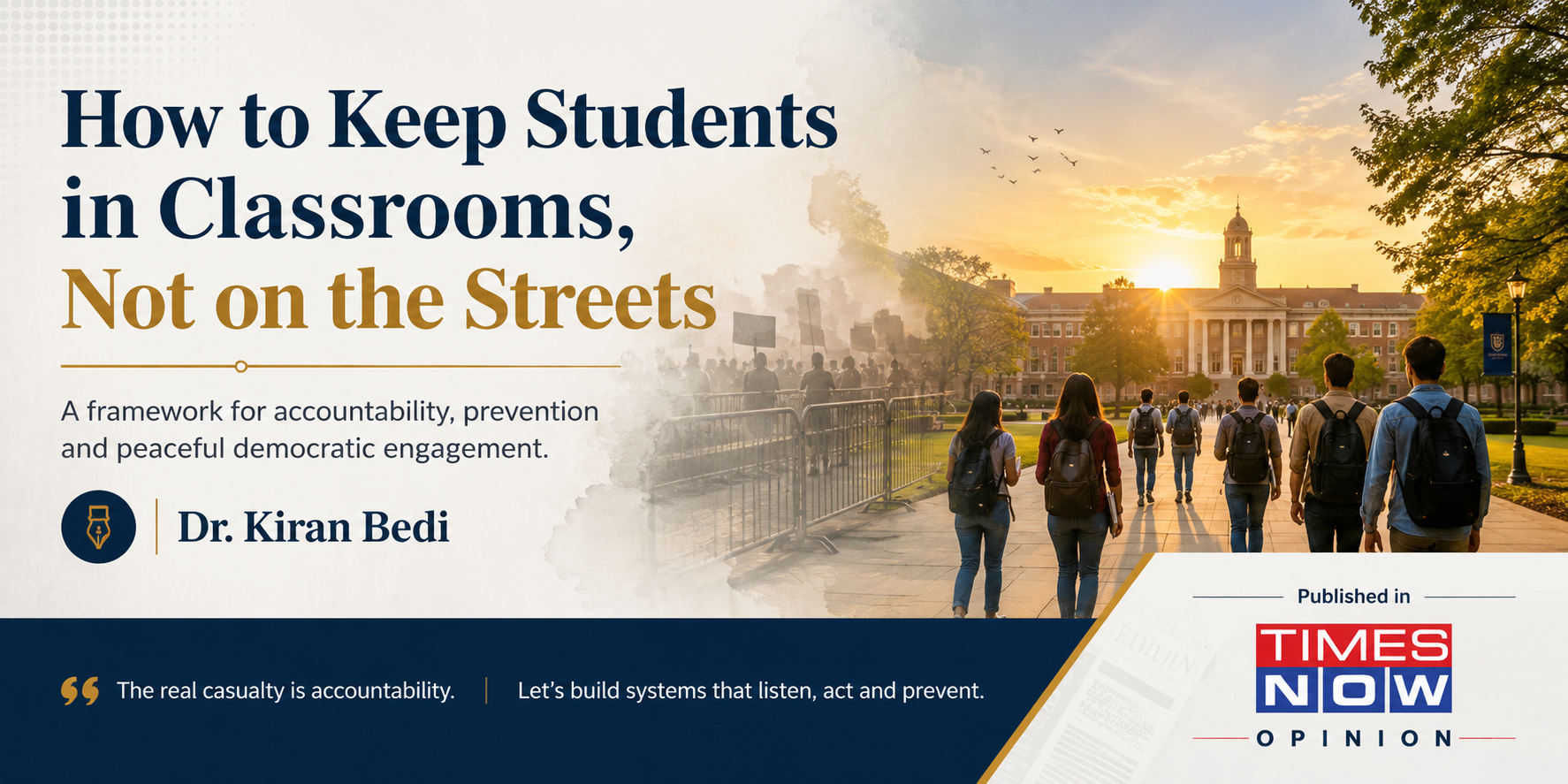
HOW TO KEEP STUDENTS IN CLASSROOMS, NOT ON STREETS
Kiran Bedi proposes a people- first approach to campus governance, arguing that accessible institutions, responsive leadership and early dialogue can prevent protests from escalating into violent confrontations.
Recent events have exposed two parallel narratives. Television channels show injured police personnel. Social media circulates images of injured students and young agitators. Each captures only one side of the confrontation.
The larger story lies elsewhere.
The real casualty is accountability.
By the time police and students confront each other, the system has already failed. Grievances have gone unheard, communication has broken down, and institutions have ceased to inspire confidence. The police are then called upon to manage a situation that should never have reached them.
The question, therefore, is not merely who was injured. The more important question is: What could have been done to prevent the confrontation?
Every educational institution exists to educate, mentor and guide. Every public institution exists to listen, respond and resolve. When these responsibilities weaken, frustration spills onto the streets.
Students do not leave classrooms because they enjoy protest. They come onto the streets when they believe the doors of institutions have closed to them.
That is where reform must begin.
First, institutionalise listening.
Every Vice-Chancellor, Principal, Director and Dean should reserve one fixed hour every working day exclusively for students. No appointments. No protocol. Just open access. A predictable opportunity to be heard is often enough to prevent frustration from becoming agitation.
Every bureaucrat, (bureaucracy and elected representatives) must open up to systematic listening and responding)
Second, establish transparent grievance redressal.
Every complaint—academic, administrative, financial, hostel-related or disciplinary—should be digitally registered, acknowledged, tracked and resolved within clearly defined timelines. Students should know who is responsible, what action has been taken, and when they can expect a decision.
Nothing erodes trust faster than silence.
Third, create continuous dialogue.
Communication should not begin only after protests erupt. Regular meetings with student representatives, faculty mentors, hostel committees and parents, where appropriate, should become part of institutional governance. Trust grows through continuous engagement, not emergency negotiations.
Fourth, strengthen mentoring and counselling.
Many campus tensions are rooted not only in policy disagreements but also in stress, anxiety, financial pressures, academic uncertainty and the feeling of being unheard. Every student deserves access to a mentor and professional counselling support. Institutions that care for the emotional well-being of students create campuses where confidence replaces alienation.
Fifth, adopt a graduated and humane response to student unrest.
Not every protest requires a police response.
Democratic societies should develop a layered system of engagement.
The first response must always be dialogue.
If tensions rise, trained Civil Defence and Home Guards should serve as the first public-order interface. Their role should be communication, mediation, reassurance and de-escalation—not confrontation. Positioned between students and the police, they can reduce tensions and create space for peaceful resolution.
Only when there is a genuine threat to life, public safety or property should riot police be deployed.
The police should remain the last resort, not the first visible face of the State.
India already has Civil Defence and Home Guard organisations across the country. With specialised training in crowd psychology, mediation and conflict de-escalation, these forces can become an effective bridge between institutions and law enforcement. Such an approach protects students, reduces injuries, safeguards police personnel and reinforces public confidence that the State is committed to resolving conflict before resorting to force.
This is not a sign of weakness.
It is a mark of mature governance.
The objective of governance is not to control crowds. It is to prevent confrontation.
The measure of an educational institution is not how efficiently it disperses protests, but how effectively it prevents the need for them.
Likewise, the measure of policing is not how often force is used, but how rarely it becomes necessary.
Parents entrust educational institutions with more than their children’s education. They entrust them with their safety, dignity, character and future.
Students learn from institutions far more than from textbooks. If institutions demonstrate fairness, students learn justice. If institutions practise transparency, students value integrity. If institutions remain accessible, students develop trust in democratic processes.
India’s campuses should be centres of learning, innovation, debate and nation-building—not recurring arenas of confrontation.
Keeping students in classrooms requires more than discipline. It requires listening, transparency, accountability and preventive leadership.
When institutions keep their doors open every day, students will have little reason to take to the streets.
And when dialogue remains the first response, riot police will rarely need to become the last.
All in position and power have to be listening posts and remain accessable to feedback and course correction. This is the way to authentic way for prevention of disruption and dislocation.
Growth to be inclusive requires peace and harmony.
For that it’s a question of collective will. A culture of listening and responding.
Today youth needs this the most.
As its their future at stake.
kiranbediofficial@gmail.com
(The writer, India’s first female IPS officer, is former lieutenant governor of Puducherry)