
TCS case: When silence becomes complicity
When complaints do not translate into credible inquiry, the failure is not legal, but organisational; organisations must treat informal signals as early warnings—not inconveniences
From my years in uniform, I have learnt one enduring truth: misconduct rarely begins as a crisis. It begins as murmurs, whispers—ignored, dismissed, minimised or buried.
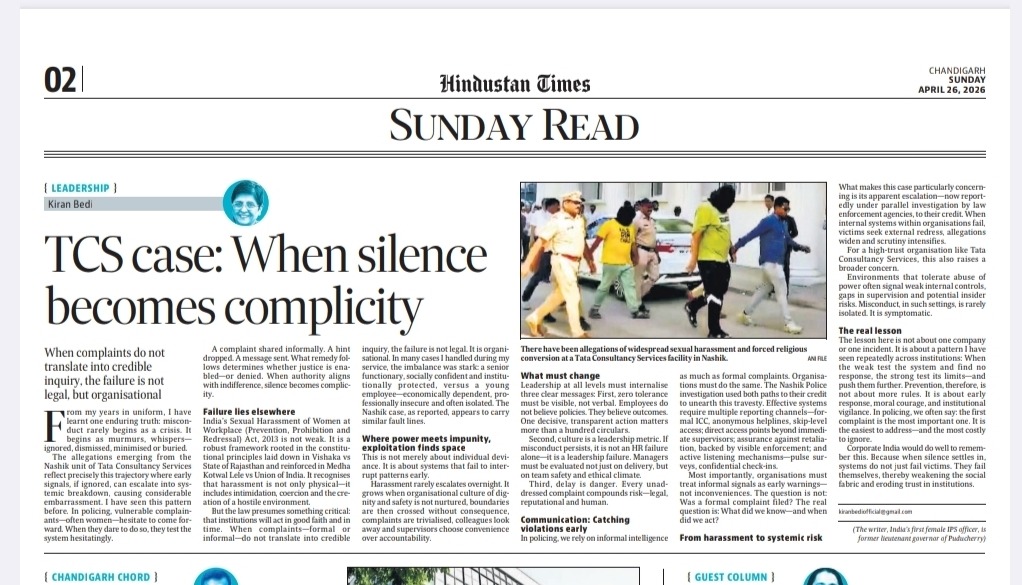
The allegations emerging from the Nashik unit of Tata Consultancy Services reflect precisely this trajectory where early signals, if ignored, can escalate into systemic breakdown, causing considerable embarrassment. I have seen this pattern before. In policing, vulnerable complainants—often women—hesitate to come forward. When they dare to do so, they test the system hesitatingly.
A complaint shared informally. A hint dropped. A message sent. What remedy follows determines whether justice is enabled—or denied. When authority aligns with indifference, silence becomes complicity.
Failure lies elsewhere
India’s Sexual Harassment of Women at Workplace (Prevention, Prohibition and Redressal) Act, 2013 is not weak. It is a robust framework rooted in the constitutional principles laid down in Vishaka vs State of Rajasthan and reinforced in Medha Kotwal Lele vs Union of India. It recognises that harassment is not only physical—it includes intimidation, coercion and the creation of a hostile environment.
But the law presumes something critical: that institutions will act in good faith and in time. When complaints—formal or informal—do not translate into credible inquiry, the failure is not legal. It is organisational. In many cases I handled during my service, the imbalance was stark: a senior functionary, socially confident and institutionally protected, versus a young employee—economically dependent, professionally insecure and often isolated. The Nashik case, as reported, appears to carry similar fault lines.
Where power meets impunity, exploitation finds space
This is not merely about individual deviance. It is about systems that fail to interrupt patterns early. Harassment rarely escalates overnight.
It grows when organisational culture of dignity and safety is not nurtured, boundaries are then crossed without consequence, complaints are trivialised, colleagues look away and supervisors choose convenience over accountability.
What must change
Leadership at all levels must internalise three clear messages: First, zero tolerance must be visible, not verbal. Employees do not believe policies. They believe outcomes. One decisive, transparent action matters more than a hundred circulars.
Second, culture is a leadership metric. If misconduct persists, it is not an HR failure alone—it is a leadership failure. Managers must be evaluated not just on delivery, but on team safety and ethical climate.
Third, delay is danger. Every unaddressed complaint compounds risk—legal, reputational and human.
Communication: Catching violations early
In policing, we rely on informal intelligence as much as formal complaints. Organisations must do the same. The Nashik Police investigation used both paths to their credit to unearth this travesty. Effective systems require multiple reporting channels—formal ICC, anonymous helplines, skip-level access; direct access points beyond immediate supervisors; assurance against retaliation, backed by visible enforcement; and active listening mechanisms—pulse surveys, confidential check-ins.
Most importantly, organisations must treat informal signals as early warnings—not inconveniences. The question is not: Was a formal complaint filed? The real question is: What did we know—and when did we act?
From harassment to systemic risk
What makes this case particularly concerning is its apparent escalation—now reportedly under parallel investigation by law enforcement agencies, to their credit. When internal systems within organisations fail, victims seek external redress, allegations widen and scrutiny intensifies.
For a high-trust organisation like Tata Consultancy Services, this also raises a broader concern.
Environments that tolerate abuse of power often signal weak internal controls, gaps in supervision and potential insider risks. Misconduct, in such settings, is rarely isolated. It is symptomatic.
The real lesson
The lesson here is not about one company or one incident. It is about a pattern I have seen repeatedly across institutions: When the weak test the system and find no response, the strong test its limits—and push them further. Prevention, therefore, is not about more rules. It is about early response, moral courage, and institutional vigilance. In policing, we often say: the first complaint is the most important one. It is the easiest to address—and the most costly to ignore.
Corporate India would do well to remember this. Because when silence settles in, systems do not just fail victims. They fail themselves, thereby weakening the social fabric and eroding trust in institutions.
kiranbediofficial@gmail.com
(The writer, India’s first female IPS officer, is former lieutenant governor of Puducherry)