After the salute, who cares for kin of police martyrs?
Instead of one-time help, support for affected families can be designed to address evolving needs, like housing, education and health care
Recently in Jammu, I attended a moving event where an NGO honoured the families of a few police officers who had laid down their lives in the line of duty. The recognition was dignified and heartfelt. It reminded everyone present of the courage and sacrifice that policing demands in a country as complex and diverse as India. Yet the moment also raised a deeper question in my mind. For every martyr’s family that receives recognition or support through such initiatives, how many others quietly continue their lives without sustained institutional care? The sacrifice of a police officer does not end with a ceremonial salute. Its impact lives on for decades in the lives of spouses, children and elderly parents.
The continuing cost of service
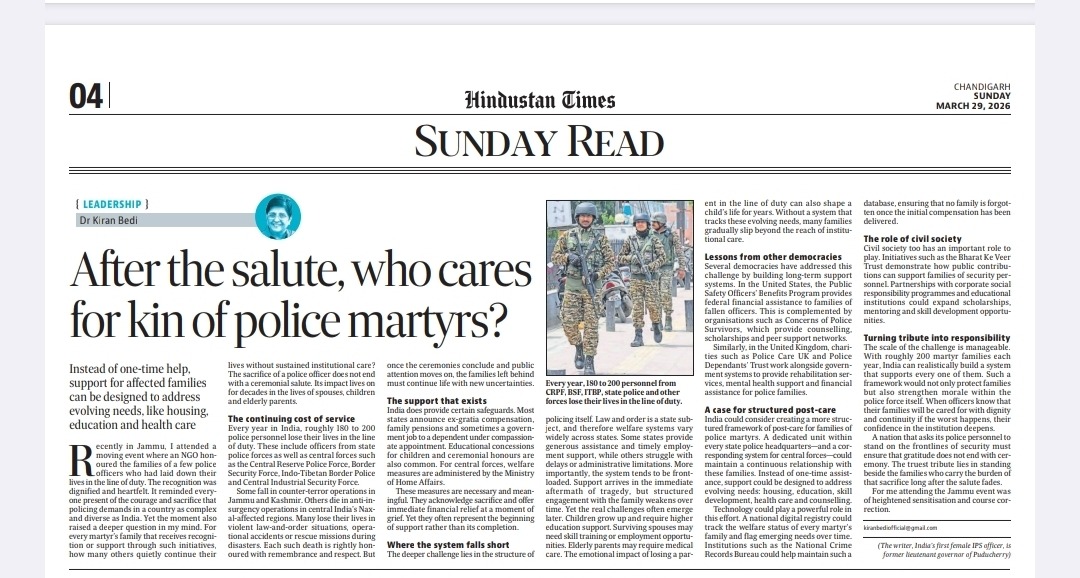
Every year in India, roughly 180 to 200 police personnel lose their lives in the line of duty. These include officers from state police forces as well as central forces such as the Central Reserve Police Force, Border Security Force, Indo-Tibetan Border Police and Central Industrial Security Force.
Some fall in counter-terror operations in Jammu and Kashmir. Others die in anti-insurgency operations in central India’s Naxal-affected regions. Many lose their lives in violent law-and-order situations, operational accidents or rescue missions during disasters. Each such death is rightly honoured with remembrance and respect. But once the ceremonies conclude and public attention moves on, the families left behind must continue life with new uncertainties.
The support that exists
India does provide certain safeguards. Most states announce ex-gratia compensation, family pensions and sometimes a government job to a dependent under compassionate appointment. Educational concessions for children and ceremonial honours are also common. For central forces, welfare measures are administered by the Ministry of Home Affairs.
These measures are necessary and meaningful. They acknowledge sacrifice and offer immediate financial relief at a moment of grief. Yet they often represent the beginning of support rather than its completion.
Where the system falls short
The deeper challenge lies in the structure of policing itself. Law and order is a state subject, and therefore welfare systems vary widely across states. Some states provide generous assistance and timely employment support, while others struggle with delays or administrative limitations. More importantly, the system tends to be front-loaded. Support arrives in the immediate aftermath of tragedy, but structured engagement with the family weakens over time. Yet the real challenges often emerge later. Children grow up and require higher education support. Surviving spouses may need skill training or employment opportunities. Elderly parents may require medical care. The emotional impact of losing a parent in the line of duty can also shape a child’s life for years. Without a system that tracks these evolving needs, many families gradually slip beyond the reach of institutional care.
Lessons from other democracies
Several democracies have addressed this challenge by building long-term support systems. In the United States, the Public Safety Officers’ Benefits Program provides federal financial assistance to families of fallen officers. This is complemented by organisations such as Concerns of Police Survivors, which provide counselling, scholarships and peer support networks.
Similarly, in the United Kingdom, charities such as Police Care UK and Police Dependants’ Trust work alongside government systems to provide rehabilitation services, mental health support and financial assistance for police families.ce.
A case for structured post-care
India could consider creating a more structured framework of post-care for families of police martyrs. A dedicated unit within every state police headquarters—and a corresponding system for central forces—could maintain a continuous relationship with these families. Instead of one-time assistance, support could be designed to address evolving needs: housing, education, skill development, health care and counselling.
Technology could play a powerful role in this effort. A national digital registry could track the welfare status of every martyr’s family and flag emerging needs over time. Institutions such as the National Crime Records Bureau could help maintain such a database, ensuring that no family is forgotten once the initial compensation has been delivered.
The role of civil society
Civil society too has an important role to play. Initiatives such as the Bharat Ke Veer Trust demonstrate how public contributions can support families of security personnel. Partnerships with corporate social responsibility programmes and educational institutions could expand scholarships, mentoring and skill development opportunities.
Turning tribute into responsibility
The scale of the challenge is manageable. With roughly 200 martyr families each year, India can realistically build a system that supports every one of them. Such a framework would not only protect families but also strengthen morale within the police force itself. When officers know that their families will be cared for with dignity and continuity if the worst happens, their confidence in the institution deepens.
A nation that asks its police personnel to stand on the frontlines of security must ensure that gratitude does not end with ceremony. The truest tribute lies in standing beside the families who carry the burden of that sacrifice long after the salute fades.
For me attending the Jammu event was of heightened sensitisation and course correction.
kiranbediofficial@gmail.com
(The writer, India’s first female IPS officer, is former lieutenant governor of Puducherry)