
Built just to inaugurate: Why PWD projects fail?
Roads and bridges constructed by public works departments often fail not from engineering gaps but negligence, missing transparency and no accountability
This piece is provoked by the last few days of exposures and happenings which compelled me to pen my anguish. India’s infrastructure crisis is not about engineering mistakes. It is about a system and a work culture that protects negligence and exposes the public to risk.
When a newly built flyover suddenly narrows, when a bridge shuts weeks after it is inaugurated, or when a freshly laid road disintegrates and leaves gaping holes, generally and before monsoons, the official explanation is always the same: a “technical failure.” This phrase has become a convenient lie. Roads and bridges built by public works departments (PWDs) do not fail by accident. They fail because the system is designed to tolerate failure, and “feed” (sic) without consequences.
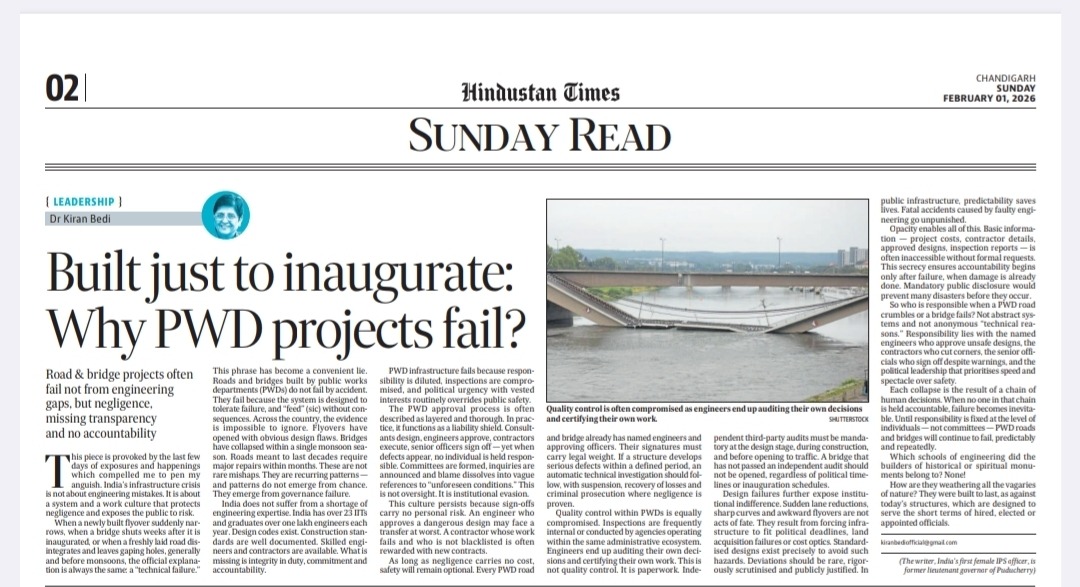
Across the country, the evidence is impossible to ignore. Flyovers have opened with obvious design flaws. Bridges have collapsed within a single monsoon season. Roads meant to last decades require major repairs within months. These are not rare mishaps. They are recurring patterns — and patterns do not emerge from chance. They emerge from governance failure.
India does not suffer from a shortage of engineering expertise. India has over 23 IITs and graduates over one lakh engineers each year. Design codes exist. Construction standards are well documented. Skilled engineers and contractors are available. What is missing is integrity in duty, commitment and accountability.
PWD infrastructure fails because responsibility is diluted, inspections are compromised, and political urgency with vested interests routinely overrides public safety.
The PWD approval process is often described as layered and thorough. In practice, it functions as a liability shield. Consultants design, engineers approve, contractors execute, senior officers sign off — yet when defects appear, no individual is held responsible. Committees are formed, inquiries are announced and blame dissolves into vague references to “unforeseen conditions.” This is not oversight. It is institutional evasion.
This culture persists because sign-offs carry no personal risk. An engineer who approves a dangerous design may face a transfer at worst. A contractor whose work fails and who is not blacklisted is often rewarded with new contracts.
As long as negligence carries no cost, safety will remain optional. Every PWD road and bridge already has named engineers and approving officers. Their signatures must carry legal weight. If a structure develops serious defects within a defined period, an automatic technical investigation should follow, with suspension, recovery of losses and criminal prosecution where negligence is proven.
Quality control within PWDs is equally compromised. Inspections are frequently internal or conducted by agencies operating within the same administrative ecosystem. Engineers end up auditing their own decisions and certifying their own work. This is not quality control. It is paperwork. Independent third-party audits must be mandatory at the design stage, during construction, and before opening to traffic. A bridge that has not passed an independent audit should not be opened, regardless of political timelines or inauguration schedules.
Design failures further expose institutional indifference. Sudden lane reductions, sharp curves and awkward flyovers are not acts of fate. They result from forcing infrastructure to fit political deadlines, land acquisition failures or cost optics. Standardised designs exist precisely to avoid such hazards. Deviations should be rare, rigorously scrutinised and publicly justified. In public infrastructure, predictability saves lives. Fatal accidents caused by faulty engineering go unpunished.
Opacity enables all of this. Basic information — project costs, contractor details, approved designs, inspection reports — is often inaccessible without formal requests. This secrecy ensures accountability begins only after failure, when damage is already done. Mandatory public disclosure would prevent many disasters before they occur.
So who is responsible when a PWD road crumbles or a bridge fails? Not abstract systems and not anonymous “technical reasons.” Responsibility lies with the named engineers who approve unsafe designs, the contractors who cut corners, the senior officials who sign off despite warnings, and the political leadership that prioritises speed and spectacle over safety.
Each collapse is the result of a chain of human decisions. When no one in that chain is held accountable, failure becomes inevitable. Until responsibility is fixed at the level of individuals — not committees — PWD roads and bridges will continue to fail, predictably and repeatedly.
Which schools of engineering did the builders of historical or spiritual monuments belong to? None!
How are they weathering all the vagaries of nature? They were built to last, as against today’s structures, which are designed to serve the short terms of hired, elected or appointed officials.
kiranbediofficial@gmail.com
(The writer, India’s first female IPS officer, is former lieutenant governor of Puducherry)